“Understanding ourselves is the beginning of lasting change.” ~ Nina
Therapy is a collaborative journey.
Taking the first step towards therapy can feel daunting. Many people arrive feeling overwhelmed, stuck, exhausted, uncertain, or simply unsure where to begin. My role isn’t to judge, criticise or tell you what to do. Instead, I work alongside you to help you understand yourself more deeply, make sense of your experiences, and discover practical ways forward that feel achievable, meaningful and sustainable.
Over more than 22 years as a qualified Counsellor, Psychotherapist and Clinical Supervisor, I have learned that lasting change rarely comes from simply trying harder. It comes from understanding ourselves with compassion, recognising the patterns that keep us feeling stuck, and gradually developing new ways of thinking, feeling and responding.
Every person who walks through my door brings a unique life story. There is no “one size fits all” approach. Therapy is tailored to your individual needs, personality, experiences and goals.
Building a safe therapeutic relationship.
The therapeutic relationship is one of the most important parts of the work we do together. Many people have spent years feeling misunderstood, judged or unheard. My aim is to create a confidential, accepting and compassionate space where you feel able to speak openly, even about the things that may feel difficult, painful or overwhelming.
When people feel emotionally safe, they are far more able to explore themselves honestly. That understanding becomes the foundation for meaningful and lasting change.
Understanding your blueprint.
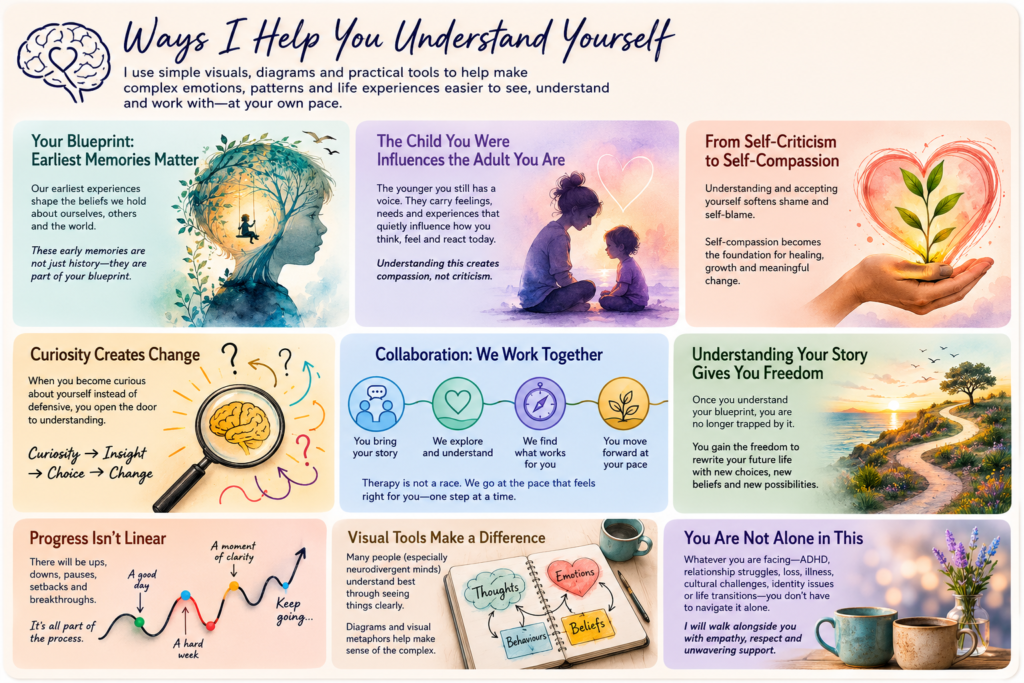
Every one of us carries an emotional blueprint that has been shaped by our earliest experiences. One of the ways I begin understanding each Client is by exploring their earliest memories. These memories often provide valuable insight, not simply into what happened during childhood, but into how those early experiences influenced beliefs about ourselves, relationships, safety, trust, belonging and self-worth.
I often say that the child you once were quietly influences the adult I meet in the therapy room.
Understanding this blueprint helps us make sense of current emotions, behaviours and relationships with compassion rather than criticism. Whilst we cannot change the past, we can understand it differently. Once we understand how our blueprint developed, we become far less controlled by it.
Helping you understand yourself.
Many people begin therapy believing there is something “wrong” with them. My experience has taught me something quite different. Most behaviours develop for understandable reasons. Whether someone is living with anxiety, ADHD, grief, relationship difficulties, trauma, health challenges or emotional overwhelm, there is usually a story behind the behaviour.
- Helping Clients understand how their mind works often reduces shame and self-criticism.
- As understanding grows, so too does self-acceptance.
- And from self-acceptance comes self-compassion.
- In my experience, self-compassion is one of the greatest facilitators of lasting therapeutic change.
- Where appropriate, I also use simple explanations, visual diagrams and practical examples to help make complex psychological concepts easier to understand.
Curiosity creates change.
One of the principles that underpins my work is that meaningful change begins when we become curious rather than defensive. Together we gently explore questions such as:
- Why do I react this way?
- What purpose has this behaviour been serving?
- What emotions sit beneath my reactions?
- What was my mind trying to protect me from?
- Is there another way forward?
- Curiosity opens the door to understanding.
- Understanding creates choice.
- Choice creates change.
- Rather than criticising ourselves for our struggles, we begin to understand them with greater compassion.
Collaboration sits at the heart of therapy.
- Collaboration is the foundation of how I work.
- I don’t believe therapy is something that is done to you.
- It is something we do together.
We work as a team to understand what has brought you to therapy, identify the patterns that are keeping you stuck, recognise your existing strengths, and develop practical ways of moving forward.
- I work at your pace, not mine.
- Some people are ready to make significant changes quickly. Others need more time to build trust, understanding and confidence. Both approaches are equally valid.
- I believe lasting change happens when people feel supported rather than pressured.
Creating meaningful and lasting change.
- Insight alone does not create change.
- Understanding ourselves is only the beginning.
- Together we work towards developing healthier habits, improving emotional regulation, strengthening relationships, increasing confidence, building resilience and creating changes that can be sustained beyond the therapy room.
- Progress is rarely a straight line.
- There will often be setbacks, difficult weeks and moments when old patterns reappear.
- Rather than viewing these as failures, we treat them as opportunities to learn more about ourselves and continue moving forwards with compassion.
Rewriting your story.
Whilst we cannot rewrite the past, we can change the influence it has over our future.
- Understanding your story gives you the freedom to write the next chapter differently.
- Once we recognise the blueprint that has shaped our lives, we are no longer limited by it.
- Instead of repeating old patterns automatically, we can begin making conscious choices that reflect who we are today, rather than who life once taught us to be.
For me, this is one of the greatest privileges of therapy – helping people discover that whilst their past may explain them, it does not have to define them.
Areas of particular interest.
Over the years I have developed particular experience supporting adults in the following areas:
- Neurodivergent adults, including ADHD and Autism.
- Couples experiencing relationship difficulties.
- Families experiencing conflict or relationship breakdown.
- Adopted adults and adoptive families.
- LGBTQIA+ individuals.
- Adults from diverse cultural and ethnic backgrounds.
- Adults experiencing anxiety, stress and significant life changes.
- Individuals living with cancer or long-term health conditions.
- Bereavement, grief and significant life losses.
Although every presenting issue is different, my approach remains the same – to provide a safe, compassionate and collaborative space where you feel heard, understood and supported as we work together towards meaningful and lasting change.
My hope for every client.
My aim has never been to “fix” people.
- I believe every person already possesses strengths, resilience and the capacity for growth, even when life has made those qualities difficult to recognise.
- My hope is that by the time therapy comes to an end, you will understand yourself more deeply, relate to yourself with greater compassion, feel more confident in your ability to navigate life’s challenges, and move forward with a clearer sense of purpose, hope and self-belief.
- Therapy is not about becoming someone different.
- It is about understanding yourself well enough to become more fully yourself.